
My Scouting Notes from Liguria 2027
You might wonder why as a mountain guide, I was out on the trails of the Italian Riviera this April? Well, the joy of shoulder-season travel means that I can use the time, where the snow is melting in the Alps to scout new destinations. And as much as I love mountains, there are many similarities between the joys and benefits of an alpine and a coastal trek. Additionally, along the coast you have the magic mix of wild, rugged ascents, stunning panoramas - accompanied by the sounds of the ocean, tastes of the local produce and a dip in the stunning waters too.


Although, this region of the Italian Riviera is synonymous with mass tourism, I went out on a quest to explore trails, routes and uncover some local gems away from the tourist hubs and Instagram hotspots. (I’ll let you into a secret here - there are so many oh-la-la spots, you really don’t need to be at the classic ones to have a moment that’s going to take your breath away or get a memorable picture.).
Nostalgia and Focaccia in Camogli
H4 Überschrift
As soon as I stepped off the train in Camogli and smelt the salty air, I knew that this was going to be a wonderful mission. Camogli has a special place in my heart, as the last time I was there was with my parents 25 years ago, as an Erasmus student on my year abroad studying in Verona. North of Portofino and the Cinque Terre area, Camogli still has the feeling of being “Real Italy” and still a popular destination for many Italians, not such a tourist mecca as the southern towns.
It’s where I experienced my first real focaccia (which I tell you is incomparable anywhere else once you’ve had it here!) and also completed one of the most memorable walks of my life with a lunch that to this day, my Dad and I still recall as the best meal ever! (Now that really means something!)
So, eager to revisit this route, fine lunch spot and fulfill my mission I spent a couple of days climbing wisteria-lined stoney staircase trails, delved into chestnut forests, stopped to examine the spring flowers and inhale the sweet scent of the blossoming mock orange. My suspicions were confirmed – spring really is the perfect time to visit. I retraced my route to that memorable lunchspot, which happens to be on the stony beach of a bay, only reachable by foot or ferry. The crystal-clear waters calling you for a refreshing dip. Well, my nostalgia was satisfied with the very same restaurant still there, even with the same coloured umbrellas! And the lunch did not disappoint. As I sat there, I was overwhelmed with gratitude for the memories of such a magical spot. I could already imagine our group of women gathered under those same umbrellas, the air filled with the sound of our shared laughter and the clinking of glasses after a morning of steep climbs. It’s the kind of spot where “quick lunches” turn into long, soul-nourishing conversations – just as much as the divine food.
Around the iconic town of Portofino, there are many trails to discover- winding through olive groves and small farms where agriculture still belongs to the locals. Just as on an alpine trek, you get to experience the produce direct from the farms – you get to see the components of your Ligurian dinners along the trails - olives and olive oil from the olive groves, pine nuts from the forests, basil and all manner of vegetable from the gardens and of course, an abundance of lemons on every hillside.
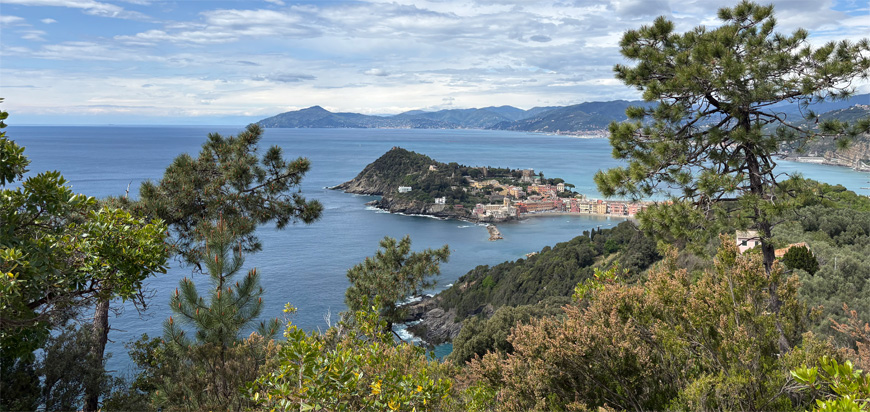
Another day I hopped on the train to the slightly larger town of Sestri Levante. Known as the “City of Two Seas”, Sestri stretches to a rocky peninsula known as l’isola (island). Not just charming now, but also to Hans Christian Andersen who stayed here in the 1800s and inspired to write many of his fairytales. Such a regarded guest that one of the bays is even named the “Baia della Favola” (Bay of fairytales), beyond the “Baia del Silenzio” (Bay of Silence). This was a delight of a destination. With a nose for a good coffee and croissant, I followed some locals into a fabulous pasticceria and adjoining focacceria to pick up a splendid picnic lunch and then climbed up through olive groves and pine forest. Across the rivieria, you find many a viewpoint is a former lookout- from times when the Genoans as a maritime republic were defending themselves (charming ruins) or Second World Wars defenses (rather less attractive bunkers). Finally, no Ligurian exploration is complete without a dip and a gelato. Sestri provided both these delights with no regrets!
After an enchanting and nostalgic few days in Camogli, I continued my journey south and was joined by a friend. We travelled onwards to Monterosso al Mare- the first village and gateway to the Cinque Terre.
Beyond the Instagram Spots
From here we started out on the classic “Sentiero Azzuro” which traces the edge of the coastline dropping you between one village and another. Grateful to be exploring at this time of year, as the villages are already much like a sunny Saturday in Kochel. That said, along the trails, the flow spread out and we found quiet pockets to rest and take in the landscapes undisturbed. The trails are still steep, uneven and narrow in parts – certainly terrain for sturdier footwear than most (I definitely looked overprepared in comparison to the majority!). When you look down upon these villages – Vernazza, Corniglia, Riomaggiore, Manarola (and Monterosso where we started), you can completely understand why so many people are drawn here. Each village has grown around a different geographical feature to enable its survival – perched on a cliff top, nestled in the mouth of a gorge or built on a peninsula. It is truly fascinating to see and the traditional use of the land and waters for daily life. Well, now lined with cafés, shops and restaurants for tourists, you just need to disappear up a little alley or find the outskirts and there you stumble on peace and quiet and a coffee for half the price!
Meeting the Locals: Heroic Agriculture
With that experience behind us, we were excited to then explore the trails beyond these villages. Over the next days, we climbed staircase after staircase, hit pine and cork forests and supped up the views from higher up – experiencing so little other foot traffic, the international travellers below seemingly a world away. We walked again through olive groves and vineyards and encountered locals out in their terraces getting their plots ready for the summer. We met a delightful lady along the way, Barbara, who inherited the plot from her grandfather and is now restoring it to its original farming purpose. They’ve rebuilt the dry-stone walls (muretti a secco) using traditional techniques (no small feat when nowadays alone the way to get the materials to these remote and inaccessible locations is by helicopter). She’s restored the lemon orchards and is now working on the olive groves. Eventually, she wants to open this as a museum into the traditional life here in Liguria. A chance encounter which I hope will be an opportunity to visit and learn more about this type of agriculture. This is why pre-visiting a destination adds so much value to a trek, as you get to really make contact with the locals and build relationships that grow each time you visit. Meeting Barbara felt like meeting a kindred spirit. For our 2027 journey, I want us to go beyond just passing through these lands; I want us to hear the stories of the women who are reclaiming these terraces. There is something deeply empowering about seeing this 'heroic agriculture' through the eyes of the women keeping the tradition alive.
The Essence of the Riviera: My "Wild" Picks and Tips
Well, I’ve got this far and haven’t even mentioned wine! Of course, the majority of culinary delights in this area can and are best washed down with a local wine. And you really can’t get more local than the local Vermentino. In fact the winemaking is as much responsible for the look of the terrain today as the olive groves. Known as “heroic agriculture” due to the physical intensity of climbing up and down terraces to manage the vines. Intrinsically linked with the history and culture of the region, visiting a winery on this route is a must.
My highlights were certainly the wilder routes higher up. Here you really get the feeling that the old ways of life are being preserved and passed on to the next generations. It’s the real side of Ligurian life still and not just a pretty picture for social media. I hope that by travelling on foot through these areas, we can be a part in supporting these communities to continue and to thrive.
Walking in Liguria is certainly not for the faint-hearted. Although the base trails can be walked (and are walked) by pretty much anyone, anything slightly off the beaten track does involve a steep climb. Trails are mixed – from stony roman mule tracks to pine forest trails and then narrow, uneven terrain which would be comparable to a T3 route in the Alps. Good footwear is essential, a standard B hiking boot recommendable.
One of the highlights of 'Wild Liguria' will definitely be our use of the local boat network. It’s not just a transfer - it’s an experience in itself. There is nothing quite like the salt spray on your face and the wind in your hair as we skip between villages, looking back at the peaks we hiked that day. It adds a layer of 'Riviera Glamour' to our rugged adventure.
Now, recce complete, I’m pulling the pieces of the puzzle together, to craft “Wild Liguria” for 2027. And when I close my eyes, I can still see that sparkling blue Ligurian sea, smell the wild thyme, lemons and pine and feel that warm Italian sun on my skin. A presto Liguria!
Why Liguria for the 2027 Women’s Trek?
Liguria is a place of contrasts - it is both tough and beautiful, much like the women who join my tours. It requires effort to reach the best views, but the reward is a deeper connection to a 'Real Italy' that most tourists simply don’t reach. Between the secret bays of Camogli and the lemon-scented air of the Cinque Terre, we’ll find a space to disconnect from the 'busy-ness' of home and reconnect with our own sense of adventure - all with a gelato or glass of Vermentino in hand and the best company imaginable.
Wild Liguria: Fast Facts
Q: When is the best time of year to hike the Ligurian Riviera?
A: April and May are truly magical. This is when the wisteria and mock orange are in bloom, the air is scented with wild herbs, and the temperatures are perfect for steep ascents. You get the "sunny Saturday" vibe without the intense heat of the Italian summer.
Q: How difficult are the trails in Liguria compared to the Alps?
A: While you are at sea level, don't let the "coastal" label fool you! The terrain is rugged and "vertical." Many trails are comparable to a T2 to T3 Alpine route - expect steep, stony mule tracks, pine forest floors, narrow coastal paths with exposed sections and plenty of stairs. A daily elevation gain of 600m - 800m is common.
Q: Is sturdy hiking footwear necessary for the Cinque Terre and Camogli?
A: Absolutely. While tourists often attempt these paths in trainers, for a safe and comfortable experience on the "wilder" trails, a standard B-rated hiking boot with good ankle support and a vibram sole is essential. The ancient stones can be very slippery, especially if there's a light sea mist.
Q: What is "Heroic Agriculture" and will we see it?
A: "Heroic Agriculture" refers to the extreme physical effort required to farm Liguria's steep, terraced hillsides. On our trek, we walk directly through these vineyards and olive groves, meeting local producers like Barbara who are restoring dry-stone walls and hand-harvesting lemons and Vermentino grapes.
Q: Can you avoid the crowds in the Cinque Terre?
A: Yes, by going "higher." While the coastal "Sentiero Azzurro" is popular, the higher ridge trails and the paths around Camogli and Portofino offer profound silence and untouched nature. We time our walks and select our routes to find those "quiet pockets" where the only sound is the ocean and the birds.
Q: Is Liguria suitable for solo female travelers?
A: Liguria is very safe and welcoming. However, joining a small group of like-minded women adds a layer of camaraderie and local insight that is hard to find alone. It turns a "walk" into a shared journey of discovery, connecting you with local culture and secret lunch spots you might otherwise skip.
Q: What is the must-try food in this region?
A: You haven't truly been to Liguria until you've had Focaccia and pesto made with young, local basil and pine nuts. Because we hike through the source of these ingredients, the connection between the trail and the plate is incredibly rewarding.
Fliestext.


Name
Comments Comments Comments Comments Comments Comments Comments Comments.
Ceri
Comments Comments Comments Comments Comments Comments Comments Comments Comments.
Name
Comments Comments Comments Comments Comments Comments Comments Comments Comments.